
2026 Federal Sentencing Guidelines Amendments: What Changed
The U.S. Sentencing Commission (USCSC) recently released the 2026 Federal Sentencing Guidelines Amendments (GSAs). These amendments were designed to simplify the Guidelines Manual for easier calculations and enhance the accuracy of sentencing decisions. This guide provides a comprehensive overview of the changes made to the Guidelines Manual, including the new guidelines, the revised sentencing ranges, and the updated sentencing policies.
Which manual applies to your cases?
The amendments are not retroactive. The Commission has not designated any of them for retroactive application under §1B1.10 at this time, so a sentence already imposed is not reduced because the new rules might have produced a lower number.
For cases still pending, the general rule in §1B1.11 is that the court uses the manual in effect on the date of sentencing, unless that would violate the ex post facto clause. In that case the court uses the manual in effect on the date of the offense. The 2026 amendments add one explicit rule: the new fine amounts apply only to offenses committed on or after November 1, 2026.
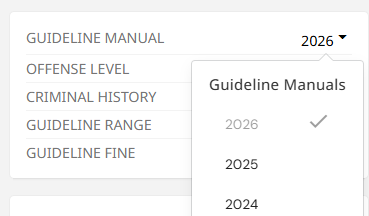
In practice this means many cases need to be run under more than one manual. Sentencing Pro lets you select the guideline year per case and compare the results.
Multiple counts
The Commission replaced the five guidelines in Chapter Three, Part D with a single guideline, §3D1.1 (Procedure for Determining Offense Levels on Multiple Counts), that contains every step needed to reach one offense level in a multi-count case. The Commission said the old rules were confusing and sometimes misapplied, which could lead to unwarranted sentencing disparities. §1B1.1(a)(4) now points to §3D1.1.
The new guideline has five subsections:
- Subsection (a), aggregate harms. For multiple counts under the same listed guideline (such as fraud, drug trafficking, firearms, and tax), the offense level is determined from the combined offense behavior taken as a whole. The listed guidelines are the same ones that required aggregation under the prior §3D1.2(d).
- Subsection (b), harm to an individual victim. For multiple counts under the same listed guideline involving different victims, or the same victim on different occasions (such as murder, assault, robbery, and sexual abuse), the offense level for each count is calculated separately to find the highest one. An adjustment from the table in subsection (b)(2) is then applied.
- Subsection (c), everything else. Counts not covered by (a) or (b) are calculated separately.
- Subsection (d), the result. Use the highest offense level resulting from (a), (b), or (c).
- Subsection (e), exclusions. Retains the provisions of the prior §3D1.1(b) identifying convictions excluded from the multiple-count rules.
The Commission describes the amendment as largely outcome neutral. It estimated that 93% of the nearly 11,000 multiple-count cases from fiscal year 2024, and 99% of all cases sentenced that year, would have seen no change in sentence. For multiple-count cases overall, the average sentence would have moved from 99.5 months to 98.9 months.
Relevant conduct (§1B1.3)
Because §1B1.3 used to refer to the old grouping rule at §3D1.2(d), it was restructured. Subsection (a)(2) now refers to a new §1B1.3(d), which lists the guidelines to which (a)(2) applies. The Commission intends relevant conduct to work exactly as it did before, even though the text looks different.
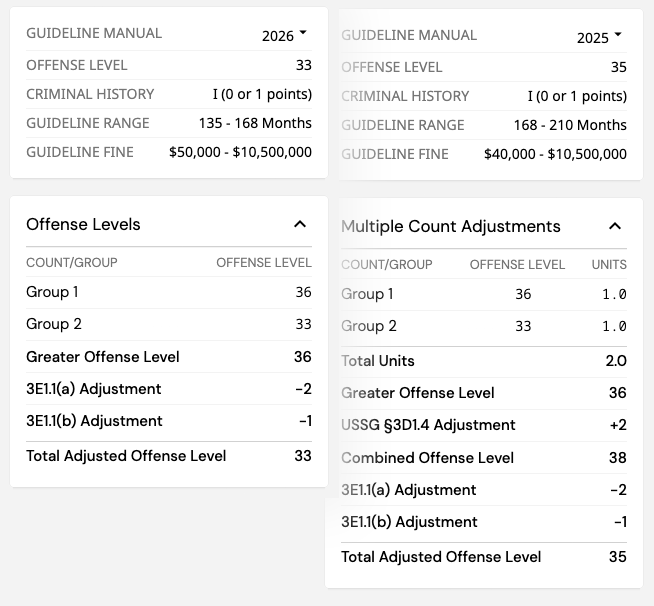
Count grouping under the 2026 manual follows the new §3D1.1 procedure. Add your counts, and the combined offense level is calculated for you. Still working on the older guidelines? We still support the complex counting method.
Fentanyl-related substances (§2D1.1)
Congress permanently scheduled fentanyl-related substances as Schedule I in the HALT Fentanyl Act and set the quantities that trigger mandatory minimums at the same level as fentanyl analogues. The Commission's amendment to §2D1.1 follows that approach. It also reflects Commission data showing that, before the Act, courts sentenced most fentanyl-related substance cases as if they involved fentanyl analogues.
- Same thresholds as analogues. The Drug Quantity Table adds a line for fentanyl-related substances at each level, and the Drug Equivalency Table sets 1 gram equal to 10 kg of converted drug weight, the same as a fentanyl analogue. Fentanyl itself remains at 1 gram to 2.5 kg.
- Statutory definition. A new Note to the Drug Quantity Table defines the term by reference to 21 U.S.C. § 812(e), so the guideline follows the statute if the definition changes.
- Rebuttable presumption. The base offense level in the table presumptively applies. If the defendant establishes that the substance (i) functions to block, diminish, or counteract the effect of fentanyl or a fentanyl analogue, or (ii) is significantly less potent than fentanyl, the court instead uses the converted drug weight of the most closely related controlled substance referenced in §2D1.1.
- Misrepresentation enhancement. Fentanyl-related substances are added to §2D1.1(b)(13) (renumbered (b)(12) in the 2026 manual; see removed characteristics), which adds 4 levels for knowingly misrepresenting or marketing the substance as something else, or 2 levels for marketing it as a legitimately manufactured drug with reckless disregard. For a fentanyl-related substance, it applies only if the court uses the Drug Quantity Table level, so it does not apply when the presumption is rebutted.
- Minimum offense level. A technical change to §2D1.6 adds fentanyl-related substances to the substances with a minimum offense level of 12.
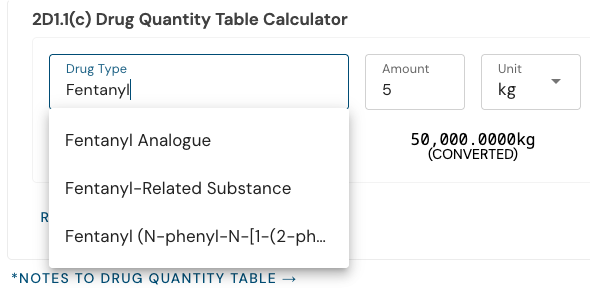
The drug calculator feeds directly into the rest of the case. Enter a fentanyl-related substance and its weight, and the converted drug weight becomes a base offense level, then a full guideline range, with statutory penalties alongside.
Monetary and fine tables
The Commission adjusted the monetary tables for inflation for the first time since 2015. It used a multiplier based on the Consumer Price Index (the Commission's figure is that $1.00 in 2014 equals $1.36 in 2025) and rounded the results. The changes reach the loss table in §2B1.1, the burglary and robbery loss tables in §2B2.1 and §2B3.1, the volume of commerce table in §2R1.1 (antitrust), the tax table in §2T4.1, the individual fine table in §5E1.2, and the organizational base fine table in §8C2.4. Dollar figures in many other specific offense characteristics were adjusted too, including in §§2B1.4, 2B1.5, 2B2.3, 2B3.2, 2B3.3, 2B4.1, 2B5.1, 2B5.3, 2B6.1, 2C1.1, 2C1.2, 2C1.8, 2E5.1, 2Q2.1, and 2T3.1.
The structure of each table is unchanged. The §2B1.1 loss table keeps its 16 tiers, and only the dollar thresholds move.
Whether the same loss amount gets a lower increase depends on where it falls in the table, so it needs to be checked for each case.
Fine tables and the offense-date rule
Fine ranges rise as well. For offense levels 20 to 22, the individual fine range moves from $15,000 to $150,000 under the 2025 table to $20,000 to $200,000 under the 2026 table. For the organizational base fine, offense level 20 moves from $1,000,000 to $1,500,000.
Both fine provisions carry a special instruction. For offenses committed on or after November 1, 2015 and before November 1, 2026, courts use the fine table in effect on November 1, 2025. The Commission added this to address ex post facto concerns raised in public comment, so the new fine amounts apply only to offenses committed on or after November 1, 2026.
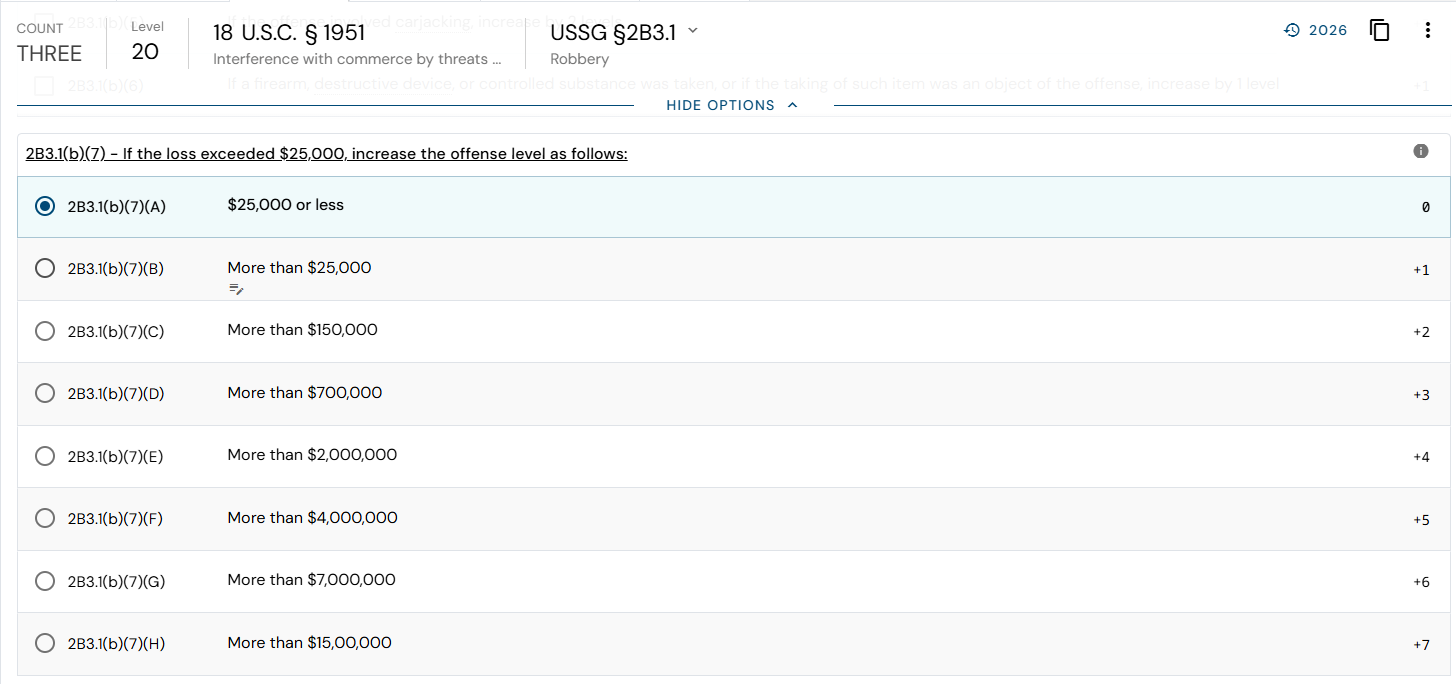
The updated thresholds are built into the 2026 manual, and the fine range follows the offense date, so one case can be checked on both sides of November 1.
Removed specific offense characteristics
As part of its multi-year effort to simplify the manual (last year's amendment eliminated departures from the three-step process), the Commission examined how often each of the 298 specific offense characteristics in Chapter Two is applied. It deleted 26 that did not apply at all in the last five fiscal years, some dating to the original 1987 manual. The Commission also found that these provisions applied infrequently, if at all, even over a 25-year lookback.
Deleting a characteristic renumbers the ones that follow, so subsection citations change. In §2D1.1, for example, the enhancement for a conviction under 21 U.S.C. § 841(g)(1)(A) is deleted, and the subsections after it move up. The misrepresentation enhancement becomes (b)(12), the aggravating-role factors (b)(15), and the safety-valve reduction (b)(17). Check any citation in a brief or PSR that refers to a §2D1.1(b) subsection.
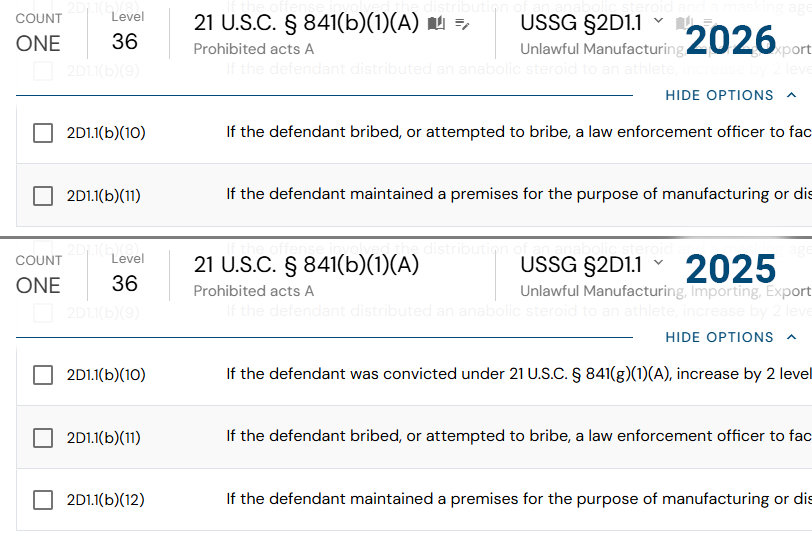
Selection lists follow the 2026 manual, so removed characteristics no longer appear and subsection numbers match the new text.
Frequently Asked Questions
When do the 2026 federal sentencing guidelines amendments take effect?
November 1, 2026. The Commission submitted the amendments to Congress on April 30, 2026, and they take effect automatically on that date unless Congress acts.
Are the 2026 amendments retroactive?
The Commission has not designated any of the 2026 amendments for retroactive application under §1B1.10 at this time.
Do the imprisonment ranges in the Sentencing Table change in 2026?
No. The 2026 amendments leave every imprisonment range in the Sentencing Table unchanged. The sentencing options amendment reorganizes and explains options that already existed.
Which Guidelines Manual applies to a case sentenced after November 1, 2026?
As a general rule under §1B1.11, the court uses the manual in effect on the date of sentencing, unless doing so would violate the ex post facto clause, in which case it uses the manual in effect on the date of the offense. Confirm how the rule applies in your circuit and case.
Does Sentencing Pro support the 2026 Guidelines Manual?
Yes. Sentencing Pro supports the 2026 manual, including the multiple-count rules, fentanyl-related substances, the updated monetary thresholds, and the date-dependent fine tables, and lets you switch guideline years within a case.
Will the multiple-counts rewrite change sentences?
The Commission designed it to be largely outcome neutral. It estimated that 93% of the nearly 11,000 multiple-count cases in fiscal year 2024, and 99% of all cases sentenced that year, would have seen no change in sentence.
Do fentanyl-related substances always get the fentanyl analogue offense level?
There is a rebuttable presumption that they do. A defendant can rebut it by establishing that the substance blocks, diminishes, or counteracts the effect of fentanyl or an analogue, or is significantly less potent than fentanyl. The court then uses the converted drug weight of the most closely related controlled substance.
Official sources
- Federal Register: Sentencing Guidelines for United States Courts (May 4, 2026)
- U.S. Sentencing Commission: Amendments to the Sentencing Guidelines, April 30, 2026 (PDF)
- U.S. Sentencing Commission: 2026 Drug Offenses Amendment in Brief (PDF)
- U.S. Sentencing Commission: 2026 Sentencing Options Amendment in Brief
This page is an informational summary for practitioners and is not legal advice. Always confirm against the official text of the Guidelines Manual.